A Planet Parade is one of the most breathtaking sights in the night sky. Although these planets are millions of miles apart, their orbits can make them appear beautifully aligned from our viewpoint on Earth.
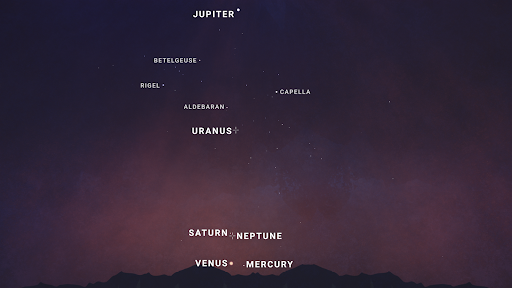
This magnificent celestial alignment will reach its peak around late February and early March 2026, shortly after sunset. During this time, Mercury, Venus, Jupiter, Saturn, Uranus and Neptune will appear aligned along the same graceful curve of the evening sky. Visibility will vary by location, but clear western horizons will offer the best views.
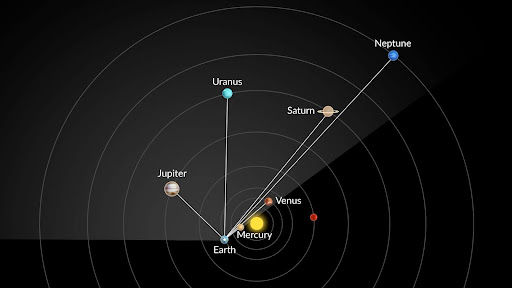
This image depicts the planetary alignment on those days when looking from above the solar system’s planets
What to Watch For:
The Bright Highlights: Venus and Jupiter will be the star of the show, shining brilliantly and easily visible even from urban areas.
Don’t Wait Too Long: Mercury, Venus, Neptune and Saturn sit low in the western sky and set soon after the Sun, so timing is crucial.
The Faint Participants: Uranus and Neptune are too faint to see with the naked eye and require binoculars or a telescope.
This image shows the late February evening sky with six planets aligned along the ecliptic
It is a beautiful reminder of the ecliptic, the flat plane in which most of our solar system’s planets orbit the Sun. Moments like this highlight the graceful order of our cosmic neighbourhood and offer a chance to see multiple worlds sharing the evening sky.
For a brief evening, the Solar System writes a quiet poem across the sky, and we are lucky enough to read it.
An extraordinary celebration of the night sky is arriving this spring. The Messier Marathon 2026, scheduled from 14 March to 22 March 2026, invites astronomy enthusiasts — from curious beginners[…]
Winter nights hold a special place in my life as a stargazing expert. Standing outside under open skies, wrapped in warm layers, beside the telescope, I guide people as they[…]
The discovery of celestial bodies near Earth often sparks excitement, curiosity, and sometimes even confusion about the possibility of a second moon. One such recent discovery, 2024 PT5, has reignited[…]
Introduction Comets have long captivated our imaginations, and this October, skywatchers are in for a treat with the appearance of C/2023 A3 (Tsuchinshan-ATLAS). This remarkable icy visitor from the outer[…]