
PLANET PARADE: The Grand March Across The Sky
A Planet Parade is one of the most breathtaking sights in the night sky. Although these planets are millions of miles apart, their orbits can make them appear beautifully aligned[…]
by astroport
March 10, 2026
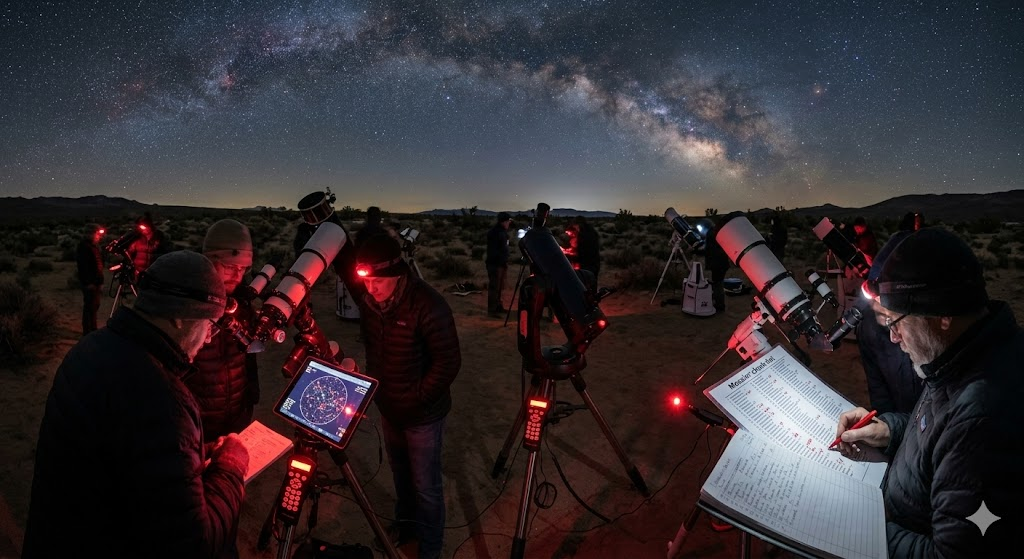
An extraordinary celebration of the night sky is arriving this spring. The Messier Marathon 2026, scheduled from 14 March to 22 March 2026, invites astronomy enthusiasts — from curious beginners to seasoned observers — to an immersive, multi-night event that combines competition, learning, camaraderie, and the sheer wonder of the universe overhead.
Held across premier dark-sky astronomy sites, this year’s event spans nine consecutive days and nights, offering participants a structured yet adventurous itinerary: from orientation sessions and telescope calibration workshops in the evenings, to deep-sky hunting competitions through the night, ending with celebrations and award ceremonies at dawn. This is not merely an event — it is a pilgrimage under the stars.
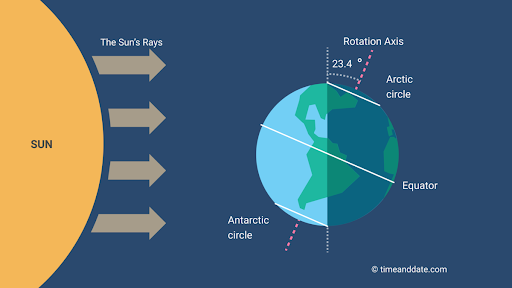
The Messier Marathon is one of amateur astronomy’s most beloved annual traditions. Each March, around the new moon, the geometry of the Earth’s orbit creates a rare window during which all 110 objects in Charles Messier’s historic catalogue, galaxies, nebulae, star clusters, and more can theoretically be observed in a single night. The marathon window typically spans late March through early April near the spring equinox, when the entire catalogue sweeps across the sky from dusk to dawn.
The Messier Marathon is the closest thing astronomy has to a sporting event. You are racing the rotation of the Earth itself, every object sets in the west while new ones rise in the east, and you have only one night to catch them all.
The 2026 edition promises unprecedented programming: structured legs of observation (First Leg, Second Leg, Third Leg, Fourth Leg), thematic night-sky hunts including the Sky Hunter and Messier Hunter competitions, the Astro-Connect treasure hunt using clues hidden in the constellations, and dedicated astrophotography sessions under pristine dark skies. By day, or rather at sunrise, participants receive awards, participate in feedback sessions, and rest before the next night’s adventure.
This event is open to individuals, families, astronomy clubs, and institutions. Participants will be provided with full orientation, equipment access, site guides, and sky charts. Whether you observe with a naked eye, binoculars, or a computerised telescope, there is a place for you at the Messier Marathon 2026.
Registration and further details will be announced through official astronomy club channels and partner institutions. Dark skies, clear eyes, and an open heart are all you need to begin.
WHAT EXACTLY IS THE MESSIER MARATHON?
The Messier Marathon traces its roots to an extraordinary coincidence of astronomy and geometry. In the 18th century, French astronomer Charles Messier (1730–1817) was on a mission to find comets. Frustrated by fuzzy, comet-like smudges in the sky that turned out to be distant galaxies, nebulae, and star clusters, he compiled a list of these nuisance objects that were definitely NOT comets — so he and other comet hunters wouldn’t waste time on them.
The result was the Messier Catalogue, published in stages between 1771 and 1781, listing 103 objects. His colleague Pierre Méchain later added objects, eventually bringing the total to 110 recognised Messier objects (M1 through M110). Ironically, what Messier compiled as a list of distractions became one of the most celebrated catalogues in all of astronomy. Today, Messier objects represent the finest deep-sky showpieces visible from the Northern Hemisphere: the Orion Nebula, the Andromeda Galaxy, the Pleiades, the Crab Nebula, and 106 more.
Why March? The Geometry of the Marathon
During a narrow window each year, roughly mid-March to early April, centered on the new moon nearest the vernal equinox, the entire Messier catalogue is positioned such that it can be observed in a single night. As the Earth rotates, Messier objects rise in the east and set in the west just like the Sun. In March, the geometry aligns perfectly: all 110 objects are above the horizon at some point between astronomical dusk and astronomical dawn.
The trickiest objects are those near the Sun — M74, M77, M33, M31, M32, M110 in the west at dusk, and M72, M73, M2, M75 in the east just before dawn. These are the “sprint” objects that must be caught in narrow windows. The bulk of the catalogue — Perseus clusters, Virgo Galaxy Cluster, Leo galaxies — fills the middle of the night. An experienced observer with a clear dark sky and a quality telescope can realistically observe 100–109 objects in one marathon night.
The Challenge —
To “complete” a Messier Marathon means to observe all 110 objects in a single night — from the first Messier object visible in the western sky after sunset to the last one rising in the east before sunrise. The entire sequence takes approximately 8–10 hours of continuous observation. Participants must move rapidly between objects, know their sky charts intimately, and battle dew, fatigue, cold temperatures, and the relentless rotation of the Earth.
At the Messier Marathon 2026, the marathon is divided into four competitive legs, with winners declared at the end of each leg. This makes the competition accessible, exciting, and rewarding even for those who don’t complete all 110 objects.
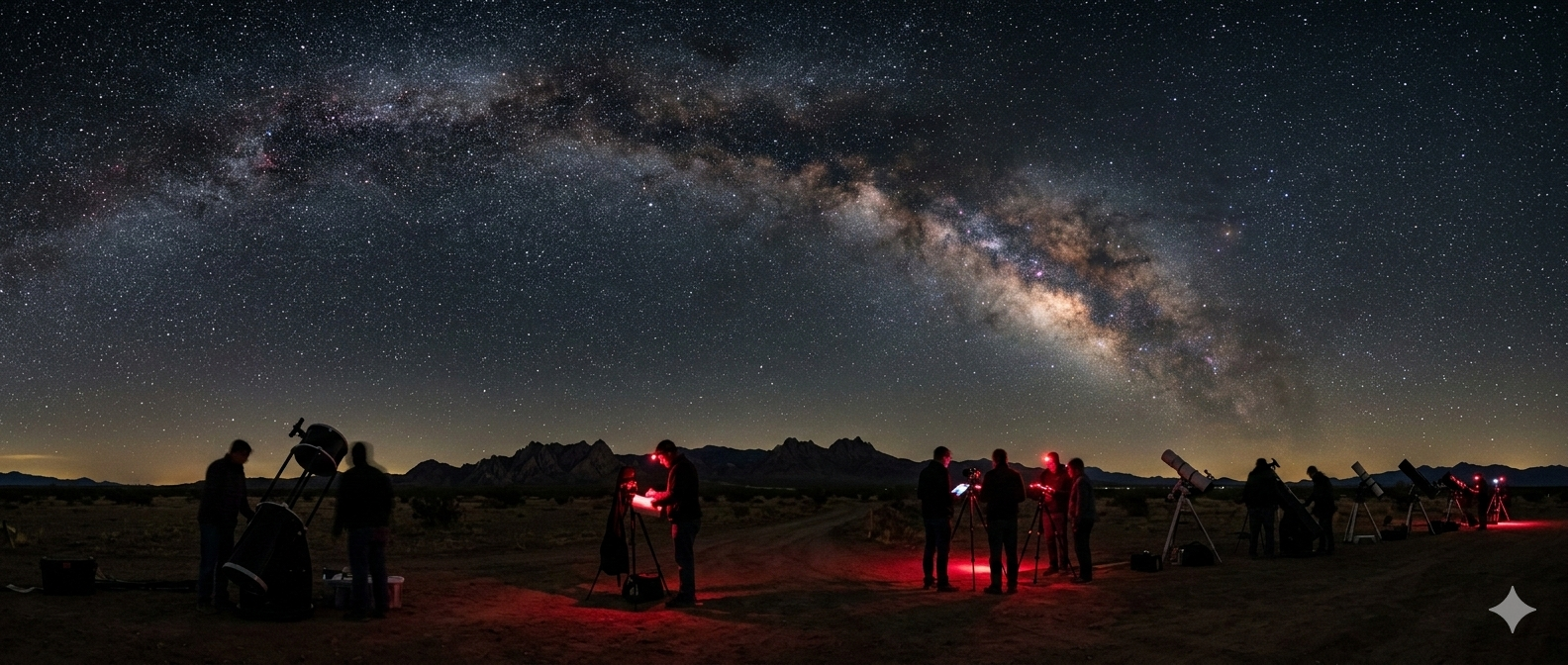
WHAT MAKES THIS EVENT UNFORGETTABLE?
The Four Legs of Hunting-
The heart of the Messier Marathon 2026 is structured into four competitive observation legs each night.
The First Leg, beginning just after dusk, targets the most challenging western Messier objects that quickly set after sunset — objects like M74 (the Phantom Galaxy), M77, the Triangulum Galaxy (M33), and the Andromeda Galaxy trio (M31, M32, M110). These require speed and precision as the sky darkens.
The Second Leg covers the rich northern and southern sky objects as the night deepens — Perseus double cluster (NGC 869 & 884), Auriga’s trio of open clusters (M36, M37, M38), Orion Nebula (M42), and the sprawling Virgo Galaxy Cluster with its 15+ Messier galaxies. This is the “endurance” leg that separates casual observers from dedicated marathon runners.
The Third Leg (on Day 2 and beyond) incorporates *astrophotography* — wide-field and mobile photography using smartphones and DSLR cameras. Participants photograph iconic objects and submit their best shots for judging. There is something magical about capturing a nebula with your phone from a dark sky site.
The Fourth Leg runs in the pre-dawn hours, targeting eastern objects rising just before sunrise — the Sagittarius and Scorpius star-cloud objects: M8 (Lagoon Nebula), M20 (Trifid Nebula), M22, M24, and the globular clusters of the galactic centre. These are among the most spectacular objects in the entire catalogue.
Astro-Connect: The Constellation Treasure Hunt
One of the event’s most unique features is Astro-Connect, a guided treasure hunt played out under the real night sky. Teams receive clues hidden in the names, positions, or lore of celestial objects. Following clues leads to physical locations at the observation site, where new challenges await. Solving each clue requires astronomical knowledge, teamwork, and creative thinking. The final treasure can only be claimed by the team that masters all the clues and challenges. It transforms the observatory into an adventure playground lit by starlight.
The Golden Hours: Dawn Observations
Some of the most emotionally powerful moments of the Messier Marathon 2026 happen in the final hour before sunrise. Participants are sleep-deprived, chilled by the night air, and running on tea and starlight and then the Sagittarius star clouds begin to rise in the southeast, bringing with them the brilliant globular clusters and emission nebulae of our galaxy’s core. Watching M8, the Lagoon Nebula, emerge from the horizon’s glow while the sky slowly brightens is a transcendent experience. Breakfast served at sunrise feels like a reward from the cosmos itself.
Awards, Titles & Badges
Every observation leg has its own champion.
Sky Hunter — awarded to the winner of the First Leg (the dusk sprint for western objects)
Messier Hunter — goes to the fastest and most accurate hunter of the Second Leg
Legend of the Night — crowns the second-leg leader on each marathon night
Genius of Heaven — bestowed upon the Third Leg winner
Fourth Leg Winner — receives their declaration at the closing breakfast ceremony
All participants receive certificates of participation, and top performers receive medals, badges, and the permanent distinction of having completed a Messier Marathon.

Pro Tips for Your First Messier Marathon
Adapt your eyes– Allow 30–45 minutes for your eyes to fully dark-adapt after leaving any lit area. Never look at a white light source. Use only dim red flashlights for reading charts.
Know your priority objects. The western sprint objects (M74, M77, M33) must be caught in the first 30 minutes after dusk. Have your telescope pre-pointed. Similarly, the eastern dawn objects (M72, M73) must be caught in the 30 minutes before sunrise. These are make-or-break targets.
Dress for cold– Even in March, observatory sites are often at elevation, and temperatures drop significantly after midnight. Layers, warm gloves, and a sleeping bag to wrap around your legs while observing are essential. Cold feet are the enemy of the marathon observer.
Stay hydrated and caffeinated wisely. Provided tea and coffee breaks are strategically timed. Avoid over-caffeinating early — you need to last until 5 AM.
DARK SKIES, LIGHT POLLUTION & WHY OBSERVATION SITES MATTER
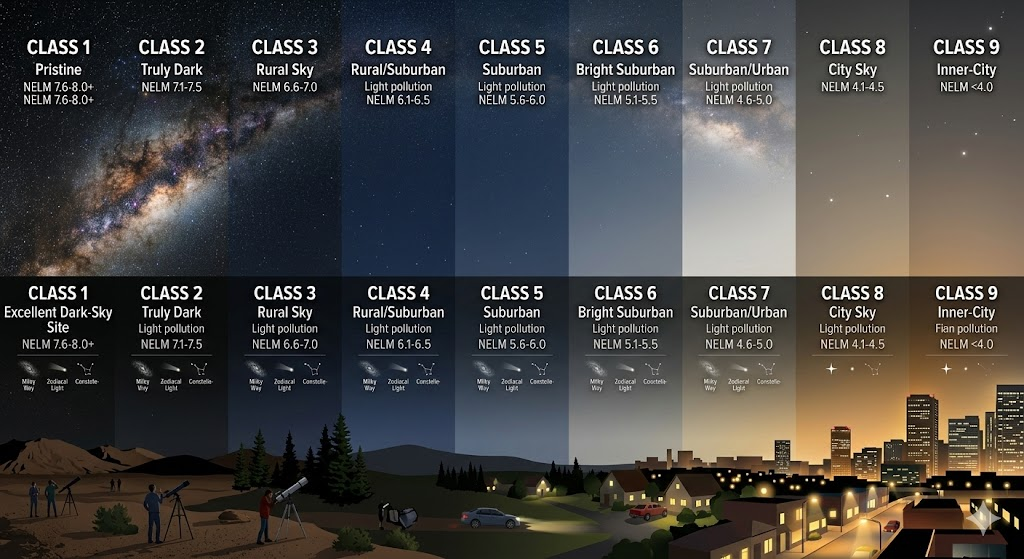
The Bortle Dark-Sky Scale (1–9) measures sky darkness:
Class 1 (Exceptional): Inner Zodiacal Light and full airglow visible. M33 direct vision. No light domes anywhere. The Milky Way casts visible shadows on the ground. Limiting magnitude~7.6–8.0.
Class 2 (Truly Dark): Zodiacal light striking in spring/autumn. M33 is easy in averted vision. Some light dome on one horizon only. Magnitude 7.1–7.5.
Class 3 (Rural): Some light pollution is evident on 1–2 horizons, but the Milky Way is still complex and detailed. Magnitude 6.6–7.0.
Class 4 (Rural/Suburban Transition): Light pollution is evident on several horizons. The Milky Way is still impressive overhead. Magnitude 6.1–6.5.
Class 5–6 (Suburban): Milky Way washed out or invisible. Many nebulae invisible. Limiting magnitude 5.1–6.0.
Class 7–9 (Urban): Only bright stars visible. The Milky Way is completely invisible. Limiting magnitude <5.0.
For a successful Messier Marathon, you need at minimum a Class 4 site, though Class 2–3 is ideal. The Messier Marathon 2026 observation sites are specifically selected in the Class 3–4 range.
ASTRONOMY AS COMMUNITY: THE HUMAN SIDE OF THE MARATHON
The Messier Marathon is, at its heart, a communal experience. There is something profoundly connecting about spending a night under the stars with a group of fellow humans, all pointing their instruments at the same ancient light. You overhear someone exclaim as they find M51’s spiral arms for the first time. You help a beginner find the Andromeda Galaxy and watch the wonder cross their face when they realise they are looking at two trillion stars 2.5 million light-years away. You share tea at 3 AM and talk about your favourite objects. You fall asleep at dawn to the sound of birdsong, having spent an entire night exploring the universe.
The Messier Marathon 2026 is designed to foster exactly this spirit. The mix of competitive legs, treasure hunts, educational sessions, and shared meals creates a community of observers that often continues long after the event ends — in WhatsApp groups, at star parties, in friendships forged under the Milky Way.
“In the southern Indian Ocean, in the high deserts of Arizona, on the plains of Rajasthan, and in backyard gardens across the world — every March, thousands of amateur astronomers turn their telescopes skyward and race the night. They carry on a tradition begun by Messier himself: the stubborn human insistence on knowing what is out there.”
Who Should Attend the Messier Marathon 2026?
Beginners – who have never looked through a telescope — you will receive complete orientation, telescope guidance, and sky charts. You don’t need to know a single star to participate; you just need curiosity.
Intermediate amateur astronomers- who know their Messier objects and want to challenge themselves with the full marathon format and competitive legs.
Experienced observers and astrophotographers – who want dark skies, camaraderie, and the structured challenge of the marathon alongside astrophotography sessions.
Students, teachers, and families – for whom this event offers one of the finest science education experiences available, learning astronomy not from a textbook but from the universe itself, in real time, with your own eyes.
Messier Marathon 2026
14 March – 22 March 2026
Registration is open through the official site, Astroport Global India
Clear skies,
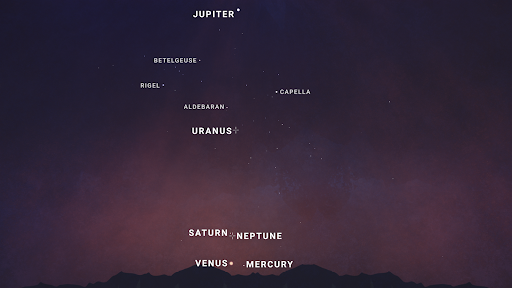
A Planet Parade is one of the most breathtaking sights in the night sky. Although these planets are millions of miles apart, their orbits can make them appear beautifully aligned[…]
Winter nights hold a special place in my life as a stargazing expert. Standing outside under open skies, wrapped in warm layers, beside the telescope, I guide people as they[…]

The discovery of celestial bodies near Earth often sparks excitement, curiosity, and sometimes even confusion about the possibility of a second moon. One such recent discovery, 2024 PT5, has reignited[…]
Introduction Comets have long captivated our imaginations, and this October, skywatchers are in for a treat with the appearance of C/2023 A3 (Tsuchinshan-ATLAS). This remarkable icy visitor from the outer[…]
Get exclusive access to freebies and news. We don’t spam, rent or sell your email. See our Privacy Policy.

